One of the questions we get asked most as an SEO and website design agency is, “Is SEO still worth it in 2026?”
It’s a fair question.
AI is the biggest buzzword in marketing right now. ChatGPT, Claude, Gemini, AI search, AI agents, automated websites, automated content, and tools that claim they can practically run your business for you have made a lot of people assume traditional search is disappearing.
And every few months, someone declares that SEO is dead.
It isn’t.
SEO is absolutely still worth it in 2026. But the way businesses need to approach SEO has changed.
Table of Contents
AI Has Changed Search, But It Hasn’t Replaced It
People are still using Google.
They are still searching Google Maps.
They are still looking at reviews, comparing businesses, reading service pages, researching products, and trying to figure out who they should trust.
But now they are also asking ChatGPT, Gemini, Perplexity, and other AI tools for recommendations.
Search did not disappear.
It expanded.
That means businesses are no longer optimizing for one single place where customers might find them.
They are building an online presence that can be understood across search engines, maps, AI tools, social platforms, review websites, directories, and other sources across the web.
And that is exactly why SEO still matters.
AI Still Needs Information to Pull From
There is this idea floating around that AI agents are eventually going to handle everything for us.
Maybe they will book the hotel.
Maybe they will find the contractor.
Maybe they will choose the restaurant.
Maybe they will compare the businesses and make the decision.
But AI still has to get that information from somewhere.
And I had a perfect example of why that matters on a recent road trip.
I used Gemini to help me find and book a pet-friendly hotel stay.
It found what looked like a great option from a major hotel chain, and based on the information Gemini surfaced, everything looked perfect.
Except it wasn’t.
Gemini had found an old special that was still indexed online.
The hotel chain had never properly removed or de-indexed the outdated page, so that information was still available for Google and AI systems to find.
Was it the end of the world? No. But, the result was not the seamless AI-powered booking experience everyone imagines when we talk about AI agents eventually handling everything for us.
It was outdated information influencing a real purchasing decision.
That is an SEO problem.
And it is a perfect example of why technical SEO, content management, indexing, and website maintenance still matter.
If your website contains outdated pages, expired promotions, conflicting information, old pricing, inaccurate business details, or content that should no longer be indexed, AI can potentially surface that information too.
SEO in 2026 is not just about trying to rank number one for a keyword.
It is also about making sure search engines and AI systems understand the correct version of your business.
SEO Is Becoming More About Understanding Your Business
Years ago, SEO could be much more mechanical.
Put the keyword in the title.
Put it in the heading.
Write a blog post.
Build some backlinks.
Repeat.
That is not enough anymore.
Search engines have become much better at understanding context, businesses, brands, expertise, locations, relationships, and whether a website actually deserves to be recommended.
Today, your SEO strategy needs to help search engines understand things like:
- Who your business is
- What services you actually provide
- Where you operate
- Who you serve
- What makes your business different
- Which pages are current
- Which pages should no longer exist
- What information about your business can be trusted
- Why your business deserves to appear in search results
That means SEO touches much more than blog content.

Your website structure matters.
Your service pages matter.
Your Google Business Profile matters.
Your reviews matter.
Your internal linking matters.
Your technical SEO matters.
Your brand mentions matter.
And yes, the actual quality of your website matters too.
Local SEO Is Still One of the Clearest Examples That SEO Works
If you want proof that SEO still matters in 2026, look at local search.
When someone searches for something like “website designer near me,” “website designer in Destin,” “physical therapist in Covington,” or “window cleaning company near me,” they are usually not doing research for fun.
They are looking for someone to hire.
That is what makes local SEO so valuable.
Google’s local results, Google Maps, organic search results, reviews, service pages, location pages, and your Google Business Profile all work together to help Google understand which businesses are the best match for that search.
And we see this firsthand with our own agency.
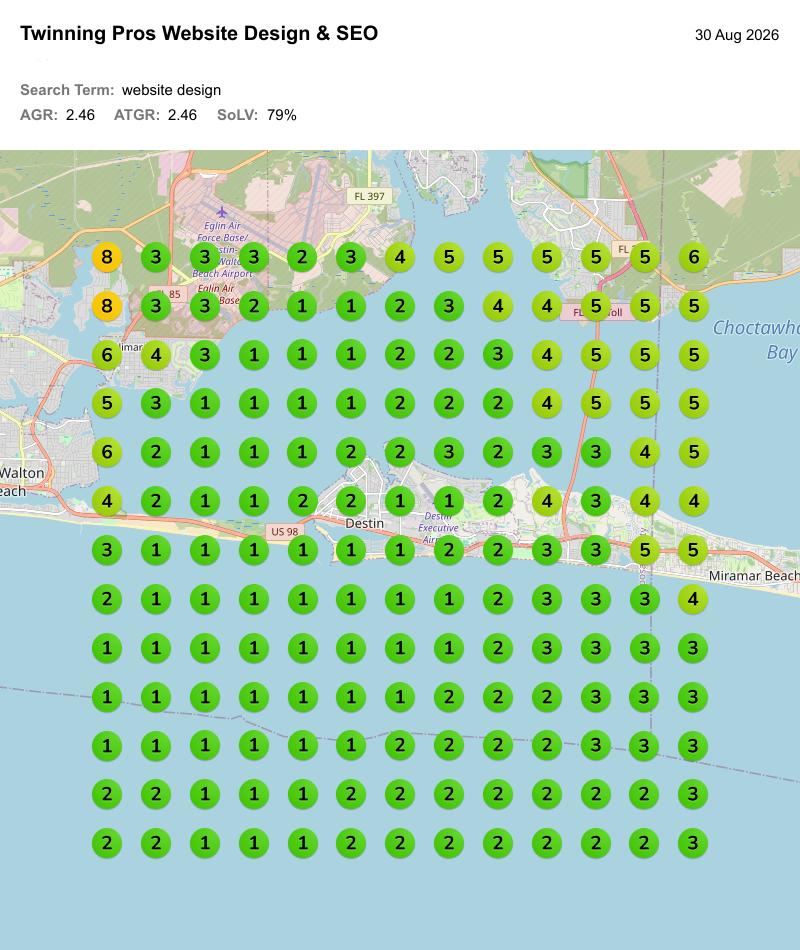
When someone searches for a website designer, we are not relying only on paid ads or hoping they happen to see one of our social media posts.
We have intentionally built our website, service pages, local presence, business listings, and Google Business Profile so Twinning Pros can appear when someone is actively searching for the services we provide.
That distinction matters.
Social media puts your business in front of people who may or may not need what you sell.
Local SEO puts your business in front of someone who is actively searching for it.
That search intent is incredibly valuable.
We see the same thing with our clients.
We helped a brand-new physical therapy practice compete in local search against businesses that had been established in the area for years.
We have helped local service businesses increase their visibility in Google Maps and organic search by improving their websites, Google Business Profiles, service targeting, technical SEO, and overall local search foundation.
None of that disappeared because AI became popular.
AI Makes Strong SEO More Important, Not Less
There is another reason businesses should care about SEO in an AI-driven world.
AI systems need reliable sources.
If an AI system is trying to answer:
“Who is the best physical therapist near me?”
or
“Who should I hire to build my business website?”
it needs information that helps it understand which businesses actually provide those services.
Your website is part of that information.
So is your Google Business Profile.
So are your reviews.
So are your service pages.
So are your business listings.
So are mentions of your business across other trusted websites.
The stronger and more consistent your online presence becomes, the easier it becomes for both traditional search engines and AI systems to understand your business.
The opposite is also true.
If your website is thin, outdated, contradictory, poorly organized, or barely explains what you do, search engines have less information to work with.
So do AI systems.
SEO Is Not Just Blogging
This is one of the biggest misconceptions we still see.
SEO does not mean publishing four blog posts a month forever.
Sometimes content is exactly what a business needs.
Sometimes it isn’t.
A local service business may get much more value from creating the right service pages, improving its website architecture, fixing technical issues, optimizing its Google Business Profile, improving location signals, earning reviews, and strengthening the pages that already exist.
Another company may have hundreds of pages and need to clean up outdated content rather than create more of it.
Remember my hotel example?
More indexed content would not have solved that problem.
Removing or correcting the outdated content would have.
That is why we do not believe modern SEO should be reduced to a checklist of how many blogs or backlinks you receive every month.
The work should be based on what is actually preventing your business from becoming more visible.
What Does SEO Look Like in 2026?
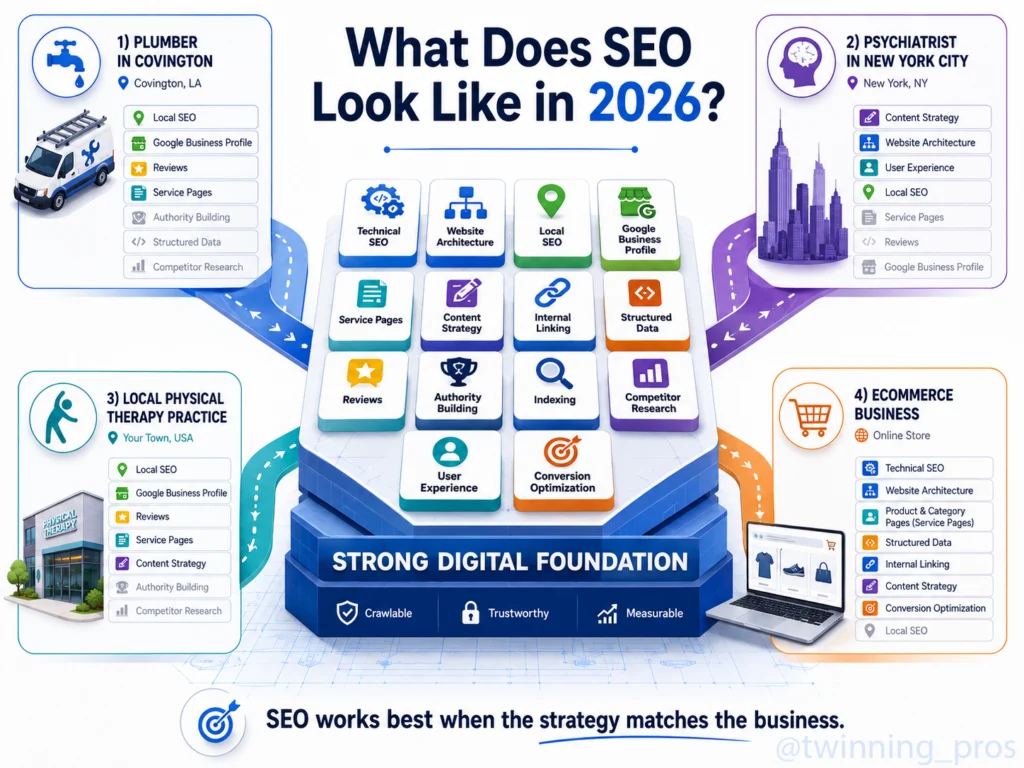
Good SEO in 2026 is about building a strong digital foundation.
That can include technical SEO, website architecture, local SEO, Google Business Profile optimization, service page development, content strategy, internal linking, structured data, reviews, authority building, indexing management, competitor research, user experience, and conversion optimization.
Not every business needs every tactic.
That is the point.
SEO should be based on your business, your market, your competitors, and the way your customers actually search.
A plumber in Covington does not need the same SEO strategy as a psychiatrist in New York City.
A local physical therapy practice does not need the same strategy as an ecommerce company.
A business with a brand-new website does not need the same strategy as a company sitting on 15 years of outdated website content.
SEO works best when the strategy matches the business.
So, Is SEO Still Worth It in 2026?
Yes.
But not because SEO looks exactly the way it did five or ten years ago.
SEO is still worth it because people are still searching.
They are searching Google.
They are searching Google Maps.
They are researching businesses.
They are comparing reviews.
They are asking AI tools for recommendations.
They are looking for products, services, experts, restaurants, doctors, contractors, hotels, and businesses every single day.
The platforms may change.
The interfaces may change.
The technology absolutely will change.
But businesses still need to be found, understood, and trusted.
That is what SEO is really about.
And as AI becomes more involved in the way people search and make decisions, having accurate, structured, trustworthy information about your business across the web may become even more important.
So the better question is not:
“Is SEO still worth it?”
The better question is:
Can your business afford to have Google and AI misunderstand what you do, or not find you at all?
If you’re looking for an SEO strategy in 2026 and beyond, Twinning Pros Website Design & Search Engine Optimization Services are here for you.




SEO for Beginners
Learn from the SEO Strategist who has 75+ first page Google rankings under her belt.
We’re marketing nerds and business strategists that have generated millions of dollars in client revenue. We're sharing the systems and strategies to help your growing business with marketing that actually converts.
We're Tiffany + Tabatha


Comments